




As the heating, ventilation, air conditioning and refrigeration (HVACR) industry accelerates toward decarbonization and high-efficiency heating solutions, one question grows increasingly urgent: Who will train the workforce capable of installing, commissioning and maintaining the next generation of low-carbon, propane-powered technologies?
Across the country, propane — not electricity alone — is emerging as a renewable-ready, highly efficient energy source capable of meaningful emissions reductions and outstanding real-world performance. But the speed at which this technology scales depends on one essential link.
HVACR Technical Colleges & Trade Schools
With access to live equipment, hands-on installation opportunities and strong support from industry leaders, these institutions can become the driving force behind the adoption of propane-fueled emerging technologies. One standout example — the gas absorption heat pump (GAHP) installation at the College of DuPage (COD) — demonstrates what is possible when the right partners align. Through a partnership with Stone Mountain Technologies Inc. (SMTI), the company behind the Anesi brand of gas absorption heat pumps, we can demonstrate how this model allows for effective and practical training as this technology’s place in the energy sector grows.
Why Propane Technology Belongs in Today’s HVACR Classrooms
Decarbonization goals are reshaping the built environment, yet millions of buildings — particularly in rural, off-grid or mixed fuel areas — cannot rely exclusively on electric heating. That’s where propane-powered technologies, particularly gas absorption heat pumps, fill a critical gap with advantages that are increasingly important:
- Superior Efficiency Performance: GAHPs leverage a thermally driven cycle that delivers efficiency exceeding 100%, outperforming traditional gas furnaces and certain electric heat pumps in cold-climate conditions.
- Major Emissions Reductions: The high efficiency of GAHPs directly reduces emissions, helping building owners, utilities and states meet aggressive climate targets without sacrificing reliability.
- Environmentally Responsible Operation: GAHP systems consume significantly less fuel, reduce total energy demand and operate with zero global warming potential, zero ozone depletion potential and zero PFAS, reducing environmental impact.
A Massive Workforce Skills Gap
Contractors trained exclusively in conventional gas furnaces or standard electric heat pumps are not yet prepared to service propane-fueled systems. The schools that address this gap now have the potential to become the engines of tomorrow’s HVACR workforce.
Setting a New Standard for Training
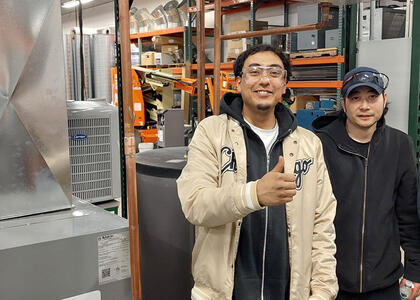
The College of DuPage’s installation of a gas absorption heat pump transformed a traditional HVACR course into a full, real-world construction and commissioning project. As a result of SMTI’s leadership and hands-on support, students gained experience that typically takes years to achieve in the field.
Students participated in:
- Performing full-site assessments
- Rerouting gas and electrical infrastructure
- Setting and mounting outdoor equipment
- Managing installation logistics
- Commissioning the GAHP system
- Analyzing live performance data
This was not a lab demonstration — it was a true, outdoor, operational installation on a functioning building.
Today, COD serves not only as a training center for HVACR students but also as a working technology showcase for contractors, utilities, manufacturer representatives and trade allies looking to understand where propane-powered heating is headed. Through COD’s partnership with SMTI, this model is replicable for other use cases.
Why Propane Industry Leaders Should Care
Industry-leading organizations — associations, foundations, propane marketers, distributors and original equipment manufacturer partners — recognize that propane must have a strong presence in decarbonization strategies. Stone Mountain Technologies places high importance on advancing this message.
For the industry to scale propane-powered innovation, leaders must:
- Invest in HVACR workforce development
- Support schools prepared to execute live installation projects
- Highlight propane as a future-focused, sustainability-aligned energy source
Projects like the COD installation show that, with the right partners, technical colleges can become regional hubs for propane innovation, shaping thousands of future technicians and influencing market acceptance at scale.
A Call to Action for HVACR Technical Colleges
Schools seeking to lead the next era of HVACR education can take a page from the COD-SMTI partnership:
- Build partnerships early. Engage with propane associations, utilities and manufacturers whose expertise and equipment support are central to successful GAHP deployment.
- Create real installation projects — not just simulations. Students require outdoor, code-compliant, operational installations to develop job-ready confidence and skills.
- Work closely with facilities teams. COD overcame internal hesitation by clearly communicating the long-term benefits for the campus and the broader HVACR community.
- Document and share your success. Early adopters should present at HVACR conferences and expos to drive national momentum for propane technology education.
Why Now?
Propane-powered heating technologies are advancing rapidly, and their success depends on a trained workforce capable of installing and servicing them. HVACR educators — particularly technical colleges — are uniquely positioned to make cutting-edge propane technology part of mainstream training.
The COD project proved that schools could do far more than teach emerging technology — they can demonstrate it, test it, expand it and lead the industry forward.
PERC Q&A
At this year’s Air-Conditioning, Heating and Refrigeration Expo, which took place Feb. 2-4, the Propane Education & Research Council (PERC) brought attention to the unique cross-industry and training opportunities available in the GHP technology manufactured by companies like SMTI.
Below, Bert Warner, director of Commercial Business Development at PERC, weighs in on the role GHPs will play for the wider propane industry going forward.
Why is it important to partner with adjacent industries, such as the HVACR industry, in training and education programs?
Warner: For the propane industry, partnering with adjacent industries like HVACR is vital. Service providers bridge the gap between fuel supply and equipment performance. Since HVACR technicians act as the primary consultants for those making equipment decisions, integrated training ensures they possess the technical confidence to recommend high-efficiency propane systems over electric alternatives. By aligning training, both industries can more effectively market viable solutions for today’s marketplace.
What is the role that gas heat pumps, like those manufactured by SMTI, play in PERC’s HVACR training programs?
Warner: PERC is currently evaluating how to include gas heat pumps into training programs. As awareness continues to grow, the need for qualified technicians is necessary to support the greater adoption of these alternative technologies.
What did PERC highlight about gas heat pumps at the AHR expo?
Warner: The real buzz at AHR year is the message that GHPs aren’t just “future tech,” they are here, fully commercialized and ready to outperform the competition right now. By hitting ultra-high efficiencies of up to 140%, these systems allow customers to stick with the reliability of propane while drastically slashing their carbon footprint. Unlike electric heat pumps that often require back up, GHPs offer genuine cold-climate superiority, delivering consistent, high-grade heat even in the harshest winters. Most importantly, they offer a common-sense path to decarbonization that doesn’t gamble on an already taxed electrical grid.