



It has been estimated that 10%-15% of all personal injury lawsuits in the United States involve a plaintiff who has tripped or slipped and fallen on someone else’s property. These lawsuits are not typical in the propane industry, but such suits — including a recent propane bollard trip and fall case — do happen from time to time. A good and interesting example recently happened in Louisiana.
In a Sept. 26 decision, a Baton Rouge federal court denied a defense summary judgment motion in such a lawsuit against the Family Dollar retail chain and a propane distributor. The plaintiff had tripped and fallen next to a cylinder exchange storage rack. The case is Stewart v. Family Dollar Inc.
Cylinder Exchange Cage
Cylinder exchange programs have been a key component of the propane industry since the 1990s. The programs offer customer convenience and enhanced safety by having the customer drop off an empty cylinder (typically a 20-pound cylinder often used with a barbecue grill) and picking up a prefilled cylinder from an exchange cage outside a retail store. The Family Dollar store in Jackson, Louisiana, offered propane cylinder exchange to its customers. There was an exchange cage containing about 18 20-pound propane cylinders on the sidewalk near the front door of the store. The store’s parking lot was next to this sidewalk, and customer vehicles were typically parked directly in front of the storage cage.
Bollards
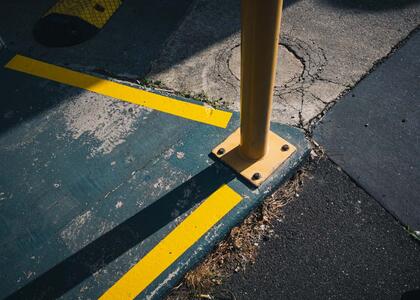
Since it was so close to the parking area, the storage cage, which contained multiple filled propane cylinders, needed protection from accidental vehicle impact. Accordingly, bollards were fastened to the sidewalk in front of the cage. A bollard is a strong steel cylinder, usually painted yellow, that is fastened in place to protect a structure from vehicle impact while still allowing pedestrian access to the structure.
In this case, the propane supplier installed two steel bollards, each painted yellow and 20 inches high, on the sidewalk in front of the cylinder storage rack at the Family Dollar store in Jackson. Each bollard was welded to a square steel plate that was then fastened into the sidewalk with four large bolts positioned at each corner of the plate. These bolts extended about 2 inches above the level of the sidewalk. One of these bolts would become the central focus of an incident involving Florence Stewart.
Unwitnessed Fall
On March 4, 2022, Stewart parked her car in the lot in front of the Family Dollar store. She entered the store and purchased some motor oil, which she took outside to her car and dispensed into the crankcase. She walked over to a trash receptacle that was next to the propane cylinder storage rack. After depositing the empty oil can in the receptacle, she started to walk back toward her car.
At this point, Stewart claims she tripped over a bolt that fastened one of the bollards to the sidewalk. She later testified that “when I turned to go to my car, a bolt caught my tennis shoe and caused me to lose my balance, and I fell face down.” She claimed that her shoe struck the bolt with sufficient force that it punctured the canvas of the shoe. The incident was not witnessed. Stewart admitted that she saw the bollards as she approached the trash receptacle but claimed that she “never saw the screws.” When asked what she was looking at after she turned back to her car after placing the trash in the can, she stated, “When I turned to go to my car — my car.”
Open & Obvious?
Stewart was injured in the fall, and she filed suit against Family Dollar and the propane supplier, claiming the bollards, and specifically the protruding bolts that fastened them to the sidewalk, constituted an “unreasonably dangerous condition” on the premises of the Family Dollar store.
The defendants responded with a motion for summary judgment, denying that the bolts were unreasonably dangerous and arguing that, in any event, they were “open and obvious” to Stewart, and she could easily have avoided them. They added that the utility of the bollards and bolts greatly outweighed any danger posed by their installation.
Addressing the “open and obvious” issue, the court noted that Stewart had presented expert testimony on the typical actions of pedestrians:
“According to Ms. Stewart, once she put the trash in the can and turned to return to her car, she was not looking at the ground directly in front of her but rather was looking at her car. There is record expert testimony that “[p]edestrians typically scan ahead in the direction of their travel, not directly down at their own feet.” Thus, a reasonable inference can be drawn from this record evidence (and a reasonable jury could so conclude) that the bolt would not have been open and obvious to a reasonable shopper because the shopper’s eyes may have been focused on the trash on the ground and/or because the shopper, after turning to return to her car, would not have been looking down at her feet (and the bolt), but at her car.”
The court also found significance in the placement of the bollards in proximity to the storage rack and the trash receptacle:
“In addition, having placed the propane kiosk on the front sidewalk near the store’s entrances/exits, and then placed a garbage can near the kiosk, it is certainly reasonable to believe that Family Dollar expected (if not encouraged and hoped for) its customers to walk in front of, view and shop for propane at the kiosk. Family Dollar would certainly have expected customers to put trash in the can placed there for that purpose by Family Dollar. Thus, a reasonable jury could conclude that the bolt would not have been open and obvious to a reasonable shopper because that shopper may have had her attention focused on the contents of the propane kiosk or the trash receptacle into which she intended to place trash.”
Based on this analysis, the court concluded there was sufficient conflicting evidence to allow a jury to decide whether the offending bolt was an “open and obvious” hazard that Stewart should have seen. The court likewise held that it was for a jury to decide whether the bollard and bolts were an unreasonably dangerous hazard and whether their utility was outweighed by any danger they presented.
The case is set for trial on Jan. 12, 2026. According to court filings, the parties are attempting to schedule a mediation prior to that time in an effort to reach a settlement.