
Propane-Powered Microgrids: Propane’s Expanding Role in Distributed Energy
Backup power generation is a key market to demonstrate propane’s reliability & how it can grow in the clean energy field
The numbers tell a stark story and highlight why interest in propane-powered microgrids continues to grow. In 2024, the United States experienced 27 total billion-dollar weather and climate disasters for a combined cost of $182.7 billion, making it the second-highest year on record behind 2023’s all-time mark of 28 events. Over the last five years, the average annual cost of billion-dollar weather events has reached $149.3 billion, more than double the 45-year historical average.
These events don’t just destroy property — they cripple the power grid. According to the U.S. Energy Information Administration (EIA), major event power interruptions averaged nearly nine hours per customer in 2024, compared to roughly four hours per year over the prior decade. Hurricanes accounted for 80% of those lost hours. A broader analysis by Climate Central found that 80% of all major U.S. power outages reported between 2000 and 2023 were weather related, and the country experienced approximately twice as many weather-related outages in the most recent decade as in the first decade of that period.
Each major grid disruption triggers a predictable response: a surge in backup power generator purchases. But the fuel powering most of those generators — diesel — introduces its own set of problems. A growing number of energy professionals are looking at a more integrated solution, one where propane serves not just as backup fuel, but as the backbone of hybrid microgrids that pair fuel-based generation with solar, battery storage and intelligent controls.
The Diesel Problem Propane Can Solve
The knee-jerk response to grid unreliability has overwhelmingly been diesel. An analysis of air quality district data found that backup generators increased by 34% in the Bay Area Air Quality Management District and by 22% in the South Coast Air Quality Management District, with roughly 90% of those generators powered by diesel. That fleet collectively produces thousands of metric tons of CO2, nitrogen oxides, particulate matter and volatile organic compounds annually.
Propane offers a cleaner alternative. Even in standard engine configurations, propane generators produce nitrogen oxide and particulate matter emissions roughly an order of magnitude lower than diesel, according to fleet emissions data analyzed by the Propane Education & Research Council. Propane is also classified as nontoxic under the Clean Air Act. Because it is a gas at atmospheric pressure, it will not pool, soak into soil or dissolve in water the way diesel or gasoline can. Propane also does not degrade over time, unlike diesel, which can break down and lose combustion quality during extended storage.
That stability makes propane well-suited for standby and seasonal systems that may sit idle for weeks or months between dispatches.
When propane is deployed through advanced generation equipment such as microturbines in a combined heat and power configuration, the efficiency gains become even more significant. CHP systems capture waste heat from electricity generation to produce hot water or climate control and can achieve fuel conversion efficiencies above 80%.
That dual output means less fuel consumed per unit of useful energy delivered — an advantage for island and remote locations where every gallon must be transported and stored on-site.
Why Propane Fits the Microgrid Equation
Microgrids are localized energy systems that can operate independently from the traditional utility grid and are one of the fastest-growing segments of the U.S. energy market. Industry analysts valued the U.S. microgrid market between $7.9 billion and $24.7 billion in 2024, with projected compound annual growth rates ranging from 13% to 19% through 2034. Combined heat and power systems represent the largest power source segment in the North American microgrid market, accounting for roughly 40% of revenue in 2024.
While natural gas and diesel have historically dominated the fuel-fired generation side of these systems, propane is gaining ground in off-grid applications where pipeline access is nonexistent and diesel delivery is expensive and unreliable.
Propane’s role in a hybrid microgrid is not simply as a backup generator fuel. When paired with solar arrays and battery storage, propane-fueled generators or microturbines can load-follow in real time, ramping up or down as solar production fluctuates and battery state of charge shifts.
Intelligent controllers manage the interplay, selecting the optimal generation source at any given moment to minimize fuel consumption and emissions while meeting demand.
The propane generation fills the gaps that renewables alone cannot for reliable generation, while the renewables reduce the total propane consumed and overall emissions. It is a complementary relationship, not a competitive one.
A Working Example in the U.S. Virgin Islands

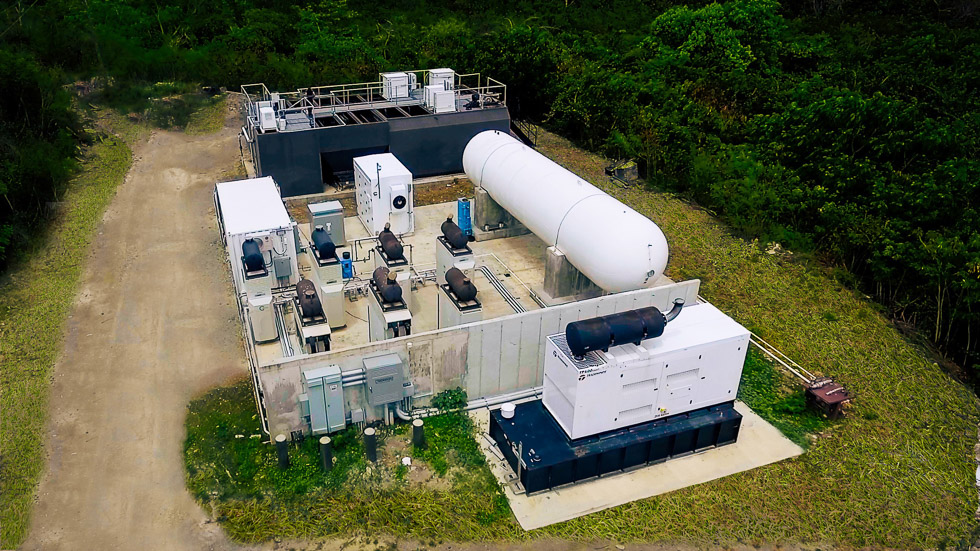
One of the most compelling demonstrations of this cross-industry approach is an affordable housing development located in St. Thomas, U.S. Virgin Islands. The 108-unit Magens Junction apartment complex was built on the site of a defunct dairy, and from the outset, the project was designed to operate entirely off grid with hurricane- hardened infrastructure.
The microgrid powering the development combines seven propane-fueled Capstone Green Energy C65 microturbines providing 455 kilowatts (kW) of generation capacity with a 150 kW solar array and an 820 kilowatt-hour (kWh) battery energy storage system.
A controller manages all three generation sources, selecting solar, microturbine or a combination of both to match real-time demand, while maintaining optimal battery charge and minimizing fuel consumption and emissions.
The system produces approximately 1 million kWh of electricity annually, along with over 1 billion Btus in hot water, generated from waste heat captured through the microturbines’ integrated heat exchangers. An 18,000-gallon propane storage tank on-site provides eight to 10 weeks of fuel autonomy before requiring a refill, a critical factor for island locations where supply logistics can be disrupted by weather.
The results speak to the value of cross-industry integration. The development saves more than $250,000 annually in energy costs compared to grid power. The system delivers uninterruptible, UPS-quality electricity to all 108 units and common areas. And the environmental impact is significant: The microgrid eliminates more than 700,000 pounds of CO2 per year relative to the island’s grid generation, the equivalent of removing more than 100 cars from the road or planting 400 acres of forest annually.
What the Propane Industry Should Take Away
Projects like this one illustrate an opportunity that extends well beyond a single island development. As microgrids gain traction in remote communities, disaster-prone regions, military installations and mission-critical facilities, propane is positioned to serve as the reliable, dispatchable generation source that makes hybrid systems viable.
For propane dealers and marketers, microgrid installations represent a different kind of customer relationship. Instead of seasonal or residential delivery, these projects create long-term, high-volume fuel contracts with predictable demand. The St. Thomas development, for example, consumes propane year-round at a steady rate.
These projects require collaboration between propane suppliers, power generation engineers, solar installers, battery integrators and intelligent controls developers.
No single generation source builds a microgrid alone. For propane professionals, that means building relationships with energy technology integrators and distributed generation specialists, partners who see propane not as a legacy fuel but as a modern, low-emission component of a clean energy system.
When propane is paired with renewables and battery storage in a CHP-enabled microgrid, the result is a system that extracts maximum useful energy from every gallon of fuel while solar and batteries reduce total consumption further. The layered efficiency positions propane as an essential and growing part of a distributed energy future.
OUR DIGITAL PARTNERS