
How Propane Tank Refurbishment Shapes Cost-Effective Asset Management
Marketers are increasingly using refurbishment strategies to extend asset life, strengthen capital efficiency & improve long-term fleet management
If you operate in propane long enough, you understand that tank inventory is more than equipment — it’s deployed capital. Propane tank refurbishment plays a critical role in how that capital is managed, helping operators extend asset life and improve long-term returns. Every tank in the field represents infrastructure earning margin over time. Every tank in the yard represents capital that is either working or waiting.
As capital discipline becomes increasingly important across the industry, more operators are taking a structured look at how refurbishment — both purchasing refurbished tanks and restoring existing fleet assets — fits into a long-term asset management strategy.
What’s emerging isn’t a trend. It’s a more intentional managing infrastructure.
Purchasing Professional Propane Tank Refurbishment
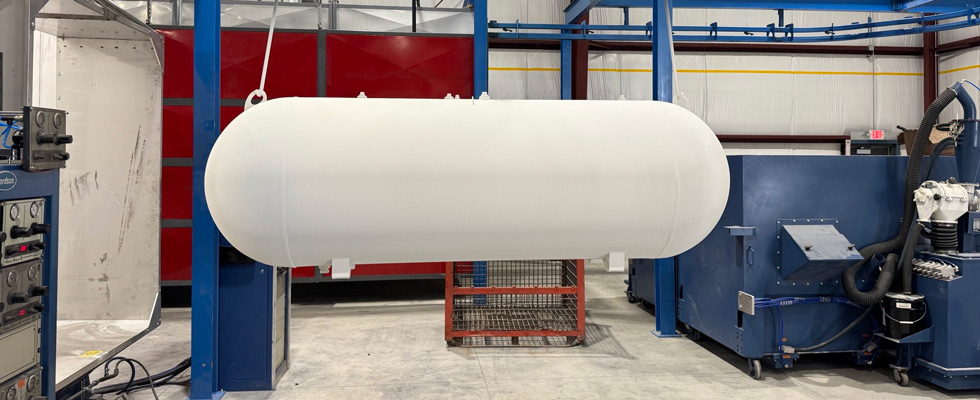
For many marketers, adding refurbished tanks to fleet inventory has become a practical capital strategy. A professionally refurbished tank is not simply repainted. A structured restoration process includes the following:
- Blasting to bare steel
- Inspection for corrosion and pitting
- Measured evaluation where necessary
- Replacement of valves and gauges
- Structural repair if required
- Application of durable coating systems
- Compliance verification completed prior to release
When this is executed under defined standards, the result is a field-ready asset prepared for deployment. From a financial view, purchasing refurbished tanks allows operators to increase deployable inventory with a lower capital requirement per unit.
Across hundreds or thousands of placements, that difference can materially affect capital allocation and payback cycles. The refurbishment benefit is straightforward. It places reliable infrastructure in the field with disciplined capital deployment.
For companies managing growth, acquisitions or seasonal inventory demands, this provides additional flexibility without compromising compliance or performance.
Refurbishing Customer-Owned Fleet Assets
Equally important is the restoration of tanks already owned by operators.
Every fleet accumulates tanks that return from service with surface corrosion, worn components or cosmetic degradation. In many cases, these tanks remain structurally sound but are removed from rotation due to appearance or uncertainty about condition.
A structured refurbishment program allows those assets to be evaluated based on inspection criteria rather than assumption.
Units that qualify are restored through a documented process and returned to service. Units that do not qualify are clearly identified. This approach creates measurable benefits:
- Extends the productive life of existing capital
- Reduces idle yard inventory
- Improves overall fleet visibility and accountability
- Strengthens return on your invested capital
Instead of writing off viable infrastructure, operators convert it back into revenue-producing assets. For large fleets, building refurbishment cycles into off-season planning smooths capital expenditure and reduces reactive equipment decisions during peak months.
Reliability & Standards Drive Confidence
In propane, reliability is nonnegotiable. A tank placed in the field must meet operational and regulatory standards, regardless of when it was manufactured.
Professional refurbishment programs operate within established Department of Transportation (DOT) and American Society of Mechanical Engineers (ASME) frameworks. Inspection, measurement where warranted, component replacement and compliance verification are not optional steps. They are foundational. The determining factor in a tank’s continued serviceability is condition and compliance, not age alone.
As refurbishment processes have matured across the industry, greater standardization and documentation have increased confidence among operators evaluating both purchase and restoration options. The focus has shifted from perception to measurable criteria.
Cost-Effective Asset Management in Practice
Cost-effective asset management does not mean minimizing investment. It means allocating capital in a way that maximizes performance over time.
Purchasing professionally refurbished tanks increases fleet capacity with disciplined capital deployment. Refurbishing customer-owned tanks restores viable infrastructure already paid for. Together, these approaches:
- Improve capital productivity
- Support measured growth
- Increase operational flexibility
- Reduce waste of usable assets
- Strengthen long-term financial stability and resilience
For operators managing multiyear capital cycles, these factors compound.
The Value of Professional Specialization
For many operators, the decision is not whether to refurbish, but how. While some level of maintenance can be handled internally, comprehensive restoration requires controlled processes, trained technicians and facility infrastructure designed specifically for tank evaluation and coating performance.
Dedicated refurbishment companies operate with equipment and workflow built for repeatability: full blast systems, measured corrosion assessment tools, standardized component replacement protocols, controlled coating environments and documented compliance verification.
When restoration is performed within that framework, operators gain consistency, labor efficiency and traceability that can be difficult to replicate on a small scale.
From a cost standpoint, specialization matters. Purpose-built refurbishment facilities spread overhead across high unit volume, reducing per-tank processing cost while maintaining inspection discipline.
For operators evaluating long-term capital strategy, partnering with a company whose sole focus is structured tank restoration can deliver both economic efficiency and process confidence.
A Practical Industry Shift
The propane industry has always been built on steady operators — companies that think long term, manage risk carefully and protect margin.
Tank refurbishment, applied within defined standards, aligns with that mindset. It treats tanks as managed infrastructure rather than single-use purchases. It emphasizes inspection-based decision-making. It strengthens both balance sheet efficiency and operational readiness.
For companies willing to evaluate refurbishment through process, documentation and measurable outcomes, it has become a practical tool in shaping cost-effective asset management across the fleet.
In an industry where durable decisions matter more than quick ones, that evolution is significant.
OUR DIGITAL PARTNERS