From CETP to PEP: Navigating the New Era of Propane Training
Everything you need to know about the PERC Education Program
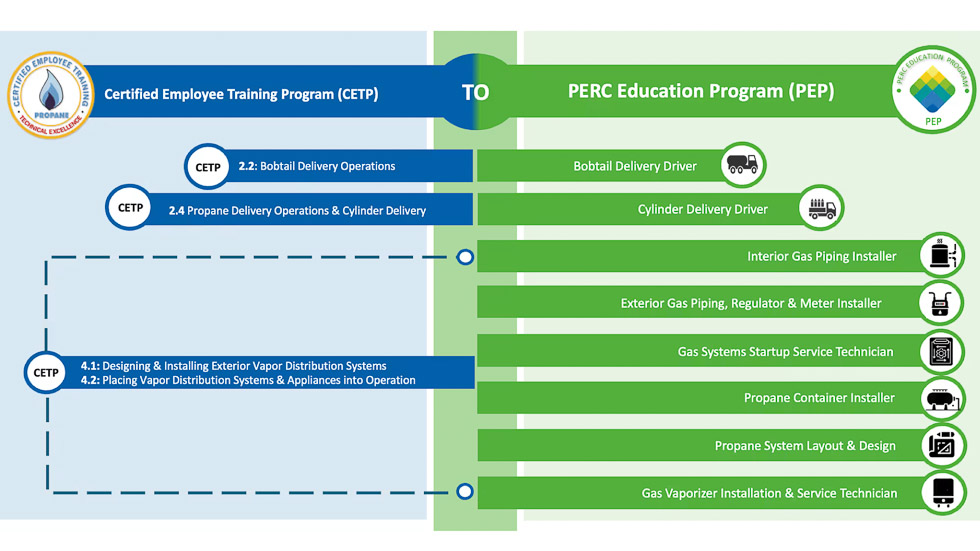
The employee education and compliance landscape has evolved rapidly in recent years, along with expectations for training, safety and workforce development. The Propane Education & Research Council (PERC) recognized the need to pivot from a one-size-fits-all approach to better serve the training and development needs of industry professionals — one that is customizable, concise, modern and designed to meet educational and compliance demands while helping streamline training for propane marketers and their teams. Building on the legacy of the Certified Employee Training Program (CETP), the new PERC Education Program (PEP) modernizes propane industry training for today’s workforce.
PERC is accredited by the International Association of Continuing Education and Training as a curriculum provider using years of safety team expertise, subject matter expert review and direct trainee feedback, ensuring high-quality, modern and effective education. As the industry transitions, users can still access their earned CETP certifications in The Learning Center, but all future professional development will now take place within the PEP framework.
PEP vs. CETP: Key Differences & Benefits
It is important to know what exactly distinguishes PEP from its predecessor, CETP, to fully understand and effectively communicate its value to industry professionals:
- Role-based vs. one-size-fits-all: With PEP, employees only need to complete the training modules necessary to safely perform their specific job, whereas CETP required professionals to be tested on the entire curriculum even if they were not required to perform all the job tasks as part of their job.
- Modular learning vs. entire curriculum: PEP is significantly more digestible, with smaller modules that have the dual benefit of improving knowledge retention and increasing course completion rates.
- Flexible customization vs. fixed learning paths: PEP emphasizes flexibility and customization; learning paths can be adjusted to meet a company’s or an employee’s needs, whereas CETP had stricter guardrails and timelines.
- Expanded training options vs. limited specialization: PEP offers an array of additional electives and advanced programs to deepen expertise, providing employers options for just-in-time training, refresher training, on-the-job training (OJT) or specialized programs that blend work with experiential learning or virtual reality-simulated exercises.
- Continuous assessment vs. final exams: CETP certification did not require any training; it relied on a comprehensive exam and skill evaluation to achieve certification. PEP is all about delivery and comprehension of targeted and effective training, using module-based assignments with continuous progress tracking, knowledge checks and quizzes throughout, and leveraging on-the-job training to ensure learners understand the material.
- Certification vs. transcript: CETP provided a certificate based on a prescribed job function. PEP tracks training as it is being done with each job function listed so you can demonstrate training compliance through a comprehensive transcript available electronically through The Learning Center anytime you need it.
Optimizing the Transition: How to Get the Most Out of PEP
Shifting to a new training framework can feel like a heavy lift, but it’s also an opportunity to audit and improve your internal development processes.
To help you hit the ground running, here are several strategic tips for implementing PEP effectively within your organization.
- Take advantage of PEP’s customization: Design training paths around real job roles in your organization, adding or removing modules to match specific responsibilities. This targeted approach avoids “training fatigue” by cutting out irrelevant material, ensuring your team focuses only on what is necessary for safe, effective performance while significantly fast-tracking their time to the field.
- Use multiple training methods: All PEP content is available in eLearning or instructor-led formats (PowerPoints, student guides and instructor notes). You can use either of these methods or use “blended learning,” which combines both online and instructor-led formats to improve the learner experience, increase retention and improve comprehension.
- Monitor, adapt and repeat: Use PEP’s continuous progress tracking to keep an eye on where employees excel and where they struggle. Gather feedback from both trainees and supervisors to refine these learning paths over time. Because PEP is versatile, you can treat your training as a living process, adjusting settings and requirements with each iteration to better optimize your results.
- Career pathing: You can use PEP training programs to map an employee’s professional growth by aligning skill development with organizational goals. By leveraging PEP’s targeted training to build required skills gradually, you can provide structured growth opportunities, resulting in higher employee retention, increased engagement and improved organizational agility.
- Stay informed: The propane industry and its regulatory requirements are always moving. Stay ahead of the curve by keeping up with curriculum enhancements and industry updates. A simple way to stay current is to sign up for PERC’s free newsletter, “Safety Matters,” which delivers the latest PEP news and safety stories directly to your inbox.
- Lean on PERC support: You don’t have to manage this transition in a vacuum. PERC provides a robust suite of tools, step-by-step guidance and expert support to help you map out your new curriculum. Reach out to the PERC team to resolve technical questions or get advice on best practices for your specific operation size.
The shift from CETP to PEP is a strategic leap toward a more flexible, efficient and role-relevant workforce. By prioritizing individualized learning over a one-size-fits-all approach, PEP allows marketers to focus training exactly where it’s needed, accelerating the journey from a new hire’s first day to their first field assignment. Embracing this versatile new standard is an opportunity to rethink your business’s growth — building a safer, more capable team that is ready to meet the demands of a modern propane landscape.
OUR DIGITAL PARTNERS