
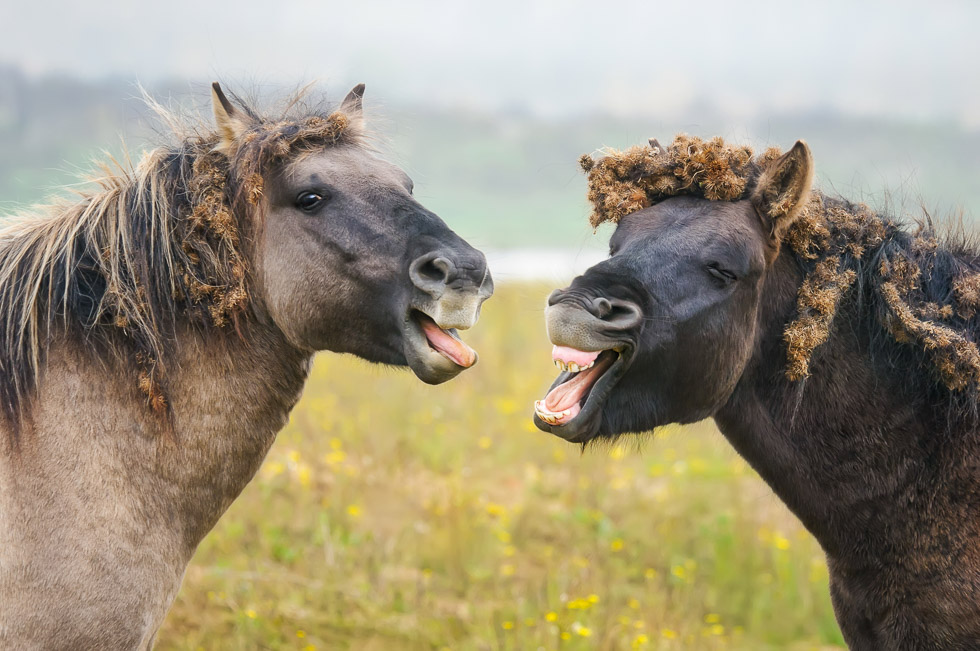
Would You Rather Have the Ability to Talk to Animals or Speak All Human Languages?
Communication is the gateway to new worlds of thought & connection, for humans & animals alike
This question really gets the wheels turning: Would you rather have the ability to talk to animals or speak all human languages on Earth? It’s one of those delightfully impossible choices that instantly reveals something about a person’s curiosity, priorities and imagination.
Reading through our colleagues’ responses was an absolute treat. Some answers were expected, yet thoughtful, and surprisingly profound, while others had me laughing out loud. The creativity, wit and personality that came through in each perspective made this far more than just a hypothetical; it became a glimpse into how differently (and wonderfully) we all think. I hope you enjoy their responses as much as I did!
In this column, adopted from the familiar “Heard on the Street” format, we offer our responders a chance to answer the question posed in the title. These are their replies, reported verbatim. Enjoy!
The Gift of Gab
If I could choose either, I would go with speaking all human languages. It would make it so much easier to connect with people and understand different cultures around the world. I would especially love it for the historical side of things. I studied history in college before joining the propane industry, and the Voynich Manuscript has always fascinated me. The idea of finally being able to read it and understand what it actually says would be incredible.
Staci Rammel
Woodruff Energy
Bridgeton, New Jersey
In our industry, communication is the most important skill there is. Being fluent in all languages would be priceless.
Jessica Johnson
National Propane Gas Association
Washington, D.C.
I would rather speak all human languages. It would be great to be able to engage with people of all cultures and learn about all the differences that make up the human race. It would be fascinating. It also would allow for me to quietly spy on so-called private conversations in languages that people assume I can’t speak — great laughs. Conversely, I would not enjoy chatting it up with the local squirrels who, like me, are high-energy chatterboxes, or getting recruited into dam building by a group of beavers. So, yeah, speaking all human languages works for me.
Robert Kenney
Metsa Tanks
McCallum, Texas
I’d choose speaking all human languages: As cool as talking to animals sounds, the ability to connect with people anywhere in the world feels more impactful. Language is leverage. It builds trust faster, shortens the distance between cultures and opens doors in business and in life that most people never even see. From a leadership standpoint, being able to communicate directly without a translator creates clarity. Clarity builds alignment. Alignment builds momentum. Whether it’s negotiating internationally, inspiring a team or simply understanding someone’s perspective without filters, that kind of access changes outcomes. There’s something powerful about being able to look someone in the eye and speak their language. It signals respect. It builds connections instantly. Talking to animals would be fun, but speaking every human language would change the game.
Mike Dodd
Propane Ninja
Tampa, Florida
Although it would be interesting to know what an animal was thinking in words (like Dr. Dolittle), I would choose to be able to speak all human languages. Animals already do a fantastic job communicating without words. Being able to communicate with any human, anywhere in the world, would be an incredible advantage — especially when traveling. In college, I traveled to Paris knowing absolutely no French, and it was a very uncomfortable experience not being able to understand or communicate with the local people. While technology makes this easier today than it was back then, having the skill to communicate in any language without relying on a phone or app would be amazing!
Abby Thurston
Rural Computer Consultants
Bird Island, Minnesota
I’d prefer being able to speak to all human beings. Certainly, it is intriguing to consider the idea of speaking with animals, but I’m not sure many would be able to carry on conversations of interest, just based on the size of their brains. (There could be exceptions like whales, dolphins, great apes and elephants.) English may be the most universal language in use today, but from the standpoint of really getting to know and understand a person, being able to communicate in their native tongue would be better.
Bruce Swiecicki
Consulting Engineer
Tinley Park, Illinois
It would be awesome to speak all human languages; I have always admired people who are multilingual. Traveling would become much easier and I could immerse myself more into other cultures. I also think it would be fun to converse with locals when traveling to other countries and be able to communicate fluently in their language. This would open up endless opportunities for Christian missions work and translating. It would be easier to order food at a restaurant, ask for directions or, more importantly, where to find the nearest bathroom.
Trevor Beaudry
Beaudry Oil & Propane
Elk River, Minnesota
Or … What Was That My Furry Friend?
I was going to choose ‘all human languages’ — that would be amazing. Then, I looked it up. There are over 7,000. Nope, not for me. I’ll stick with doing a better job on the English language and to talk to the animals, the furry ones in particular. Even though our world is large, my sphere of influence is limited. I am happy to stay in that space and show up for those people and pets in the best way possible.
Julie Johnson
Ted Johnson Propane
Baldwin Park, California
While the idea of speaking all human languages is really intriguing, I think I’d have to go with the ability to talk to animals! We have an 11-year-old basset hound named Haggard (yes, after the country singer), and I would love to know what goes on in that brain of his based on some of the looks we get and the sounds he gives us.
Kirsten McAlpin
Conger LP Gas Inc.
Tifton, Georgia
Without hesitation, I would rather speak with animals. Who wouldn’t want to know what their pets are thinking when they stare at you and cock their heads in that inquisitive manner? Plus, I’d like to connect with the gentler side of God’s nature.
Judy Taranovich
Proctor Gas Inc.
Proctor, Vermont
Observing animals is a reminder of how expressive the natural world is. To translate their language — verbal and nonverbal — would be fascinating. It might even solve my household’s current mystery, like why my cat chooses to sleep in the cardboard shipping box rather than the $60 memory foam bed it delivered — a choice she makes with the serene confidence of someone who pays no bills.
Lucy Shaffer
Shaffer’s Bottled Gas Inc.
Hooversville, Pennsylvania
Communication Is the Key
Whether understanding and speaking every human language or deciphering every bark, chirp and gentle nuzzle, communication remains the most empowering tool we possess. It is the bridge that turns confusion into clarity, isolation into connection and strangers into neighbors. Some of us are drawn to the richness of human conversation and the exchange of stories, cultures and ideas spanning continents. Others feel most at home in the quiet loyalty of the animal kingdom, where trust is built not just through words, but through presence and intuition.
At our core, we all crave to be heard, understood and to know that our voice matters. Communication, whether spoken, signed, sung or silently shared, reminds us that we are not alone in this vast and beautiful world. Regardless of where you find your place, there is dignity in your voice, value in your perspective and love in the connections you nurture. Communication is the sacred thread that weaves every living being together, whether spoken in many tongues or whispered in a single bark — reminding us that to be heard, to be understood and to be loved is the greatest language of all.
OUR DIGITAL PARTNERS